Pull up two listings under "Crystal Falls" on any given week and the math stops making sense. One is a modest single-story that closed for $285,000 in February 2026. Another, sitting on the same golf course, is a 4,498-square-foot estate that closed for $1.4 million the year before. Same community name. Same golf club address line. A gap of well over a million dollars.
Buyers who are comparing neighborhoods usually assume a wide range like that means the data is noisy, or that one of the two homes must be an outlier. Neither is true. Crystal Falls isn't a single housing market wearing one name. It's a federation of distinct sections, each with its own gate status, its own lot sizes, its own builder roster, and, most tellingly, its own line item on the homeowners association bill. If you want to understand what a Crystal Falls price actually buys, the HOA statement is a more honest starting point than the listing price.
One HOA, Two Different Bills
Every property in Crystal Falls belongs to the same master association, the Crystal Falls HOA, governed by one set of covenants and one board. That part is simple. What isn't simple is what residents actually pay. According to the association's own current billing schedule, homeowners in The Highlands and The Boulders pay $63 a month. Homeowners in Grand Mesa pay $104 a month, made up of the same $63 base assessment plus a $41 road fund.
That $41 is not decoration. It is the price of a private road behind a gate. The Highlands and The Boulders sit on public streets maintained through the standard assessment. Grand Mesa does not. Neither, on current listings, do The Fairways or Cap Rock, both of which show monthly dues in the mid-$70s, consistent with the same private-road premium showing up in Grand Mesa's bill.
That distinction is worth sitting with, because it is the cleanest, most concrete proof that "Crystal Falls" describes at least two different products: sections on public infrastructure and sections behind a gate paying to maintain their own. Everything else about the price spread, from lot size to builder to golf course frontage, tends to follow that same line.
Five Sections, Five Different Starting Points
The community groups into named sections that read almost like separate subdivisions, because in practical terms they are.
| Section | Gated | Monthly HOA Dues | What the Dues Cover |
|---|---|---|---|
| The Highlands | No | $63 | Standard landscaping and amenity upkeep |
| The Boulders | No | $63 | Same standard assessment, plus access to the Grotto Pool and beach volleyball court |
| Grand Mesa | Yes | $104 ($63 base plus $41 road fund) | Private road maintenance behind the gate |
| The Fairways | Yes | Roughly $77 on current listings | Private roads and gated golf-course-adjacent infrastructure |
| Cap Rock | Yes | Roughly $77 on current listings | Same private-road premium, with frontage along the 3rd through 6th fairways |
The Boulders, developed starting in 2003 by builders including Gehan Homes, Village Builders, and Lennar, holds some of the community's oldest housing stock, with lots running from about a sixth of an acre to just over a third. The Highlands followed with a mix of home styles zoned to Winkley and Knowles Elementary and anchored by the Quarry Park amenity center, which carries a junior Olympic pool, a splash pad, a fishing lake, and a disc golf course.
The Fairways and Cap Rock sit on the other side of the gate. The Fairways built out over nearly two decades, from 2005 into 2022, with lots ranging from a fifth of an acre up to 1.3 acres and a builder list that includes David Weekley, Highland Homes, Giddens Homes, and several custom builders. Cap Rock came later, built primarily between 2013 and 2021, with roughly 120 stone and stucco homes framed by the golf course's 3rd through 6th fairways, built by Drees, Grand Haven, Brookfield Residential, and Dream Finders.
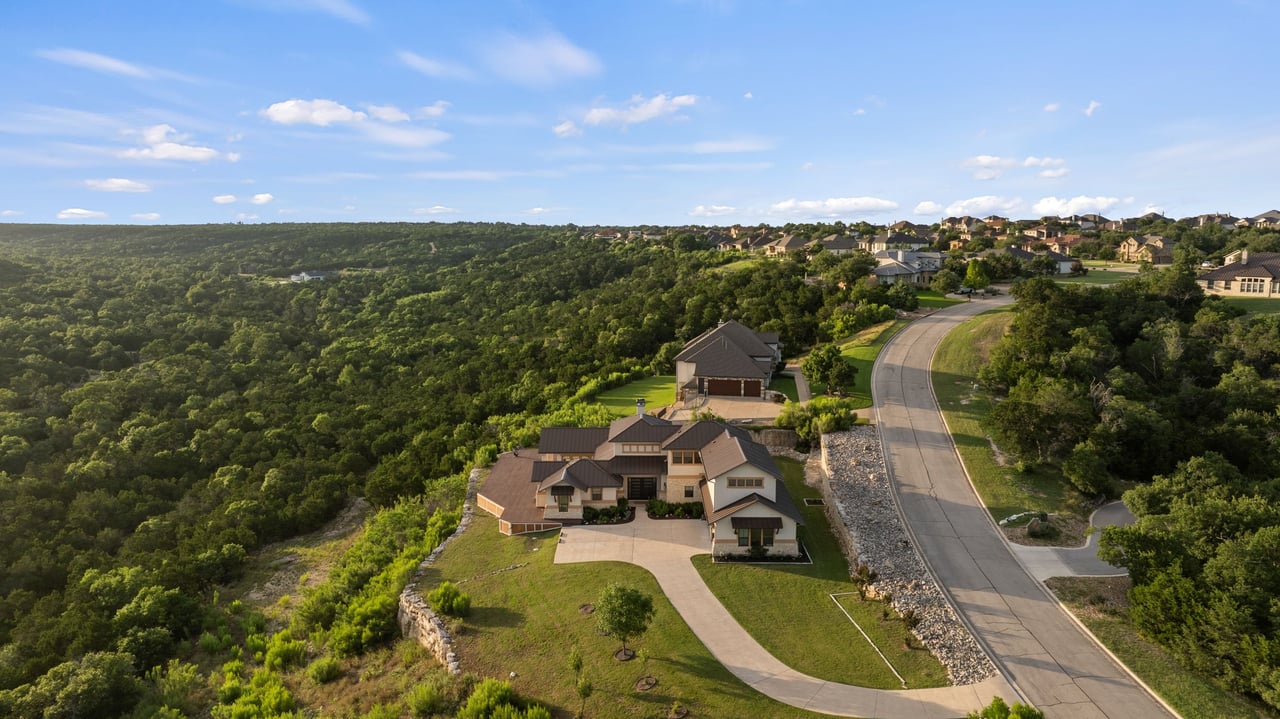
Grand Mesa sits furthest from the entry-level end of that range: a gated enclave of expansive custom homes on large, wooded lots, built for buyers who want space and privacy inside the larger Crystal Falls footprint. Two smaller gated pockets round out the picture, The Cottages, a lock-and-leave section of fewer than 60 homes, and The Townhomes of Crystal Falls, a 90-unit gated community near the retail center. Neither shows up on most people's mental map of "Crystal Falls," but both are technically the same community under the same HOA.
The Tax Line Nobody Mentions at the Open House
Dues are the visible split. The less visible one shows up on the county tax bill. Because Crystal Falls spans overlapping taxing entities, combined county, city, and MUD or PID layers can push the effective property tax rate into a range of roughly 2.2 to 2.5 percent depending on exactly where in the community a home sits. That range sounds small until you run the math on a $500,000 home: the difference between the low end and the high end of that band is over $1,500 a year, every year, for as long as you own the home.
That gap doesn't track the HOA's gated versus non-gated split cleanly. It tracks which specific taxing districts a given section falls into, which can shift block by block even within the same named section. It is the kind of detail that never shows up in a listing photo, and it is exactly the kind of number a buyer should ask about before writing an offer, not after closing.
What a Year of Closed Sales Actually Shows
The section-by-section differences in dues, lot size, and tax exposure eventually show up as the price spread buyers notice on portals. Over roughly the past year, closed sales tied to the Crystal Falls Golf Course address have ranged from a 1,399-square-foot, four-bedroom home that closed for $285,000 in February 2026, to a 3,443-square-foot home that closed for around $990,000 in December 2025, to a 4,498-square-foot estate that closed for $1.4 million in March 2025.
None of those numbers are wrong. They are three different products inside one community, and the section name attached to each listing tells you more about which of those products you're looking at than the price does on its own. A buyer comparing a Boulders resale to a Grand Mesa custom build isn't comparing two homes in the same market. They're comparing two markets that happen to share a golf course and a mailing address.
Reading a Crystal Falls Listing Like Someone Who Lives Here
If you're actively comparing homes here, the section name should be the first thing you check, not the last.
- Confirm the section before you compare price per square foot. A Highlands home and a Fairways home at the same price point are not interchangeable products.
- Check the HOA dues line against the section. If it's near $100 a month or in the mid-$70s, you're behind a gate paying for private road maintenance. If it's closer to $63, you're on public streets.
- Ask which taxing entities apply to that specific lot, not just the general Crystal Falls range. The MUD or PID assessment can move the effective rate by a quarter point or more between sections.
- Note the build era. The Boulders and the original Highlands phases date to the early-to-mid 2000s. Cap Rock and later Fairways phases run into the early 2020s. That gap shows up in floor plans, ceiling heights, and finish-out, not just square footage.
- Separate golf course frontage from golf course access. Living on the Crystal Falls Golf Club's fairways is a Fairways or Cap Rock feature. Living in the community with course access as an amenity applies more broadly.
None of this makes one section better than another. It makes them different products that happen to share a clubhouse, a school district, and a name.
FAQ
Is Grand Mesa a separate neighborhood from Crystal Falls, or part of it? Grand Mesa is a gated section within the larger Crystal Falls master-planned community, governed by the same HOA but carrying its own higher assessment tied to private road maintenance.
Do all Crystal Falls sections have equal access to the golf club? The Crystal Falls Golf Club is a public 18-hole course open to the surrounding community, so access itself isn't restricted by section. Direct fairway frontage is limited to specific sections like The Fairways and Cap Rock.
Are HOA dues the only real difference between sections? No. Dues are the clearest signal because they're published and current, but lot size, build era, builder roster, and the specific combination of taxing entities on a given lot all move independently of the HOA line.
Comparing homes across a community this layered is easier with someone who tracks the differences section by section, not just the headline average. If you're weighing a move into Crystal Falls, or trying to make sense of why two listings under the same name don't compare the way you expected, Sherri Farias can walk through the specific section, dues structure, and tax picture that applies to the home you're actually looking at. Let's Connect.