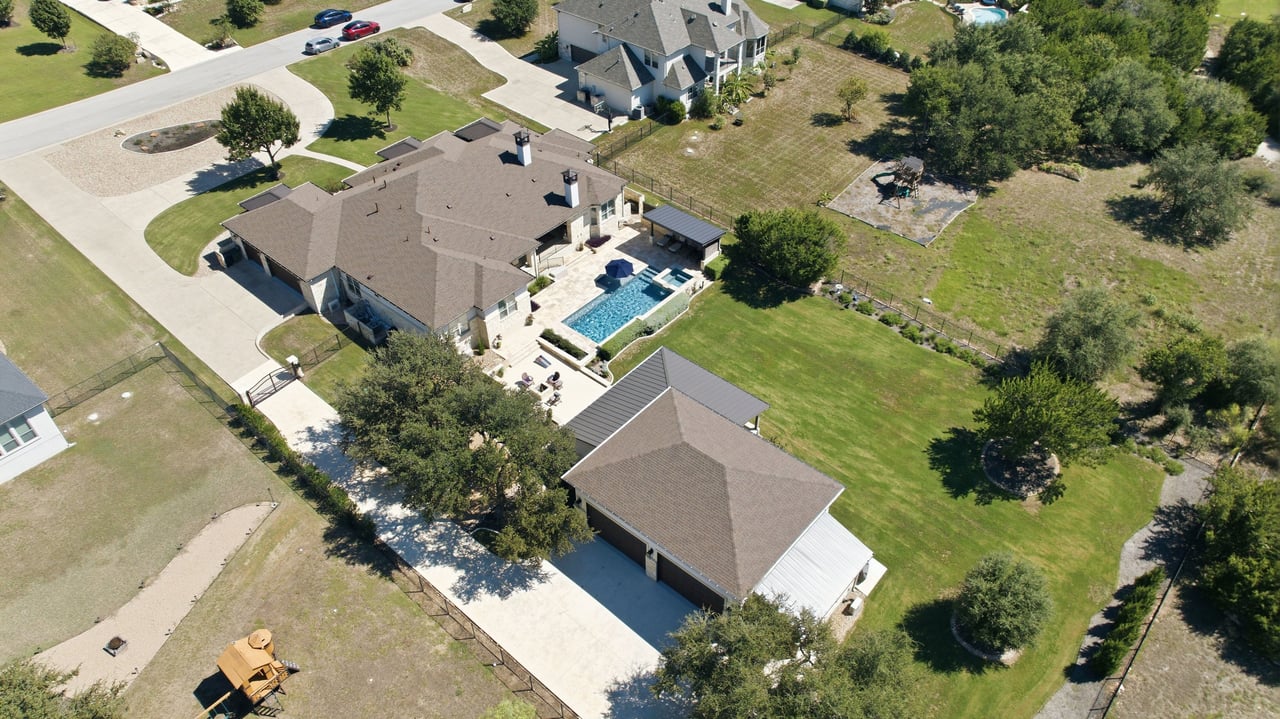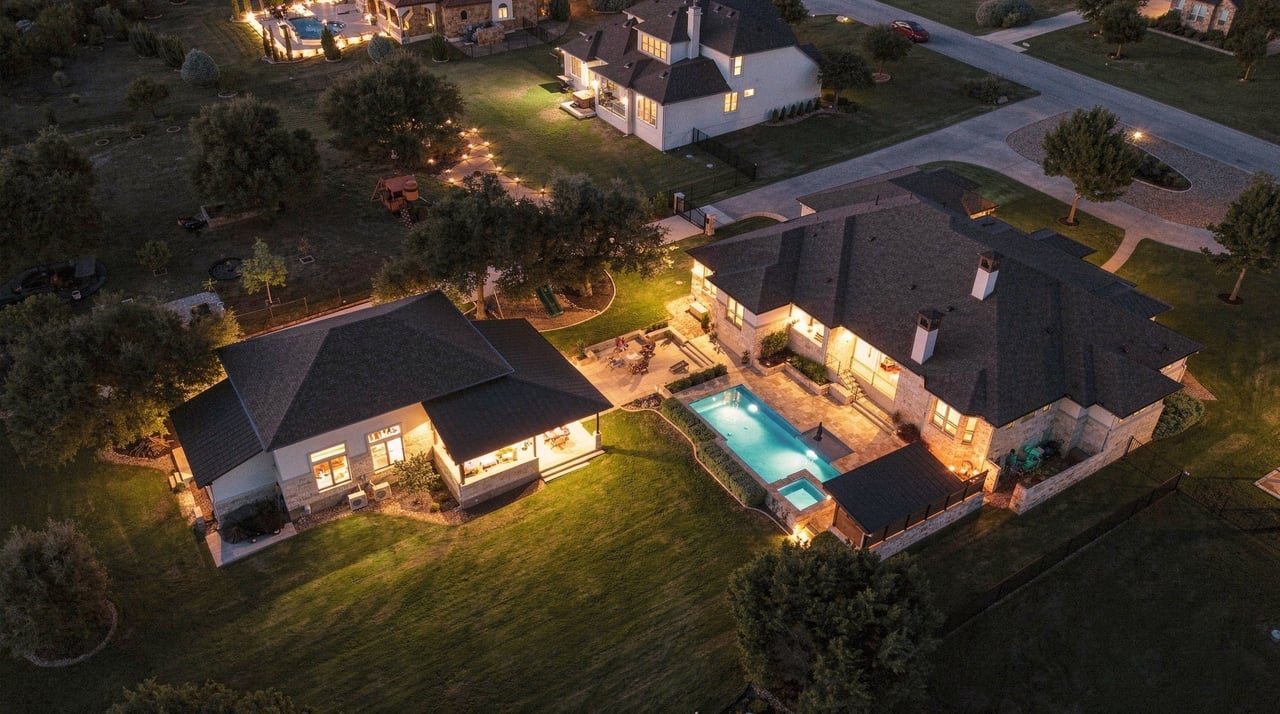
A buyer touring Ranch at Cypress Creek can walk out of one house, cross a shared fence line, and walk into a second house that pays its property taxes to a different county than the first. Same subdivision. Same HOA. Same swim season at Milburn Park. Different appraisal district entirely.
That is not a quirk. It is how Cedar Park actually works, and it rarely shows up in a portal search or a listing sheet. The city's median price gets quoted as if Cedar Park were one market with one tax rate and one school pipeline. It is not. Three lines run through the city that a buyer needs to see before falling for a subdivision name: a county line, a school district line, and a utility district line. None of them follow the roads you'd expect, and all three change what a house actually costs to own.
Two Appraisal Districts, One City Limit
Cedar Park sits mostly in Williamson County, but a real slice of the city extends into Travis County, mostly along the southern and western edges. That single fact means two different government bodies decide what your home is worth for tax purposes. Homes in the Williamson County portion get appraised by the Williamson Central Appraisal District. Homes in the Travis County portion answer to the Travis Central Appraisal District instead. Different staff, different appeal calendars, different comparable-sales pool.
Here's where it gets counterintuitive. Property tax data compiled for 2026 shows the Travis County slice of Cedar Park carrying a median home price of roughly $745,434, well above the Williamson County slice's median of about $446,174. You'd expect the pricier homes to pay the steeper percentage rate. They don't. The Travis County portion's median effective tax rate runs closer to 1.22 to 1.36 percent, while the Williamson County portion runs higher, around 1.49 to 1.52 percent. In dollar terms, the Travis County homes still pay more overall, roughly $9,558 to $10,193 a year against a Williamson County median bill near $7,028. But the rate itself, the number that actually tells you how hard your specific parcel is being taxed relative to its value, is lower on the pricier side of the line and higher on the more affordable side.
That reversal is the whole reason a single "Cedar Park tax rate" is close to meaningless. Quote the citywide average and you're blending two populations of homes that behave in opposite directions. Ask which side of the county line a specific address sits on, and the number becomes useful.
You can check any specific parcel yourself. The Williamson Central Appraisal District and the Travis Central Appraisal District both let you search by address to confirm which jurisdiction actually appraises the property and what the current assessed value looks like.
Same Street, Different Homeroom
The county line and the school district line do not travel together, which is its own trap. Most of Cedar Park is zoned to Leander ISD, but the city's southern and easternmost neighborhoods are wholly or partially served by Round Rock ISD instead, feeding elementary campuses such as Old Town and Patsy Sommer. Anderson Mill West, one of the city's original, more affordable pockets, straddles the Williamson and Travis county line in its own right, and the whole neighborhood pulls from Round Rock ISD rather than Leander ISD regardless of which county side a given block sits on. The county line and the school line cross the same subdivision on two different axes.
Meanwhile, back in Ranch at Cypress Creek, the same neighborhood that splits across the county line stays entirely inside Leander ISD, feeding Deer Creek or Westside elementary, Cedar Park Middle, and Cedar Park High. Two families in that community can pay taxes to two different counties while sending their kids to the exact same schools. Two families a few streets over in the southern part of the city can share a county and still land in different districts entirely.
The practical takeaway is simple. A neighborhood name on a listing is a starting point, not a school assignment. Attendance boundaries shift, some streets split from the block next to them, and the only way to know for certain is to check the specific address against the district's own boundary tool, not the marketing copy. Round Rock ISD publishes an interactive boundary map for exactly this reason.
Here's a quick reference for how this plays out across a few well-known Cedar Park communities:
| Area | County | Typical School Assignment |
|---|---|---|
| Ranch at Cypress Creek | Spans both Williamson and Travis County parcels | Leander ISD (Deer Creek or Westside Elementary, Cedar Park Middle, Cedar Park High) |
| Anderson Mill West | Spans both Williamson and Travis County parcels | Round Rock ISD |
| Twin Creeks | County not specified | Leander ISD |
| Southern and eastern edge neighborhoods (feeding Old Town, Patsy Sommer) | Mixed | Round Rock ISD |
Twin Creeks, for context, is the golf course community built around private club amenities and larger, more mature lots, which is why resale pricing there consistently runs at the top of the Cedar Park market. It is served by Leander ISD. More broadly, the examples above show that county and school district boundaries do not always align.
The Utility Tax That's Supposed to Shrink
Layer a third line on top of the first two. A number of newer Cedar Park subdivisions sit inside a Municipal Utility District, a special taxing entity created to finance the water, sewer, and drainage infrastructure a new development needs before the city extends its own service lines. MUD taxes typically add somewhere in the range of a quarter to a half percentage point on top of the base county rate, and that add-on rarely gets spelled out clearly on a listing sheet. It shows up in the annual tax bill, not the marketing flyer.
The detail worth knowing before you write an offer is that a MUD rate is not fixed for the life of the loan. As the district pays down the bonds that funded the original infrastructure, the rate ratchets downward, sometimes for years, and in some cases the district eventually dissolves into the city's own utility system entirely once the debt is retired, as Grewal Regroup explains. A MUD tax that looks like a real cost today may look smaller in five years, or it may not move at all if the district issued new bonds for a later phase of construction. The only way to know which situation you're in is to ask for the district's specific bond schedule, not just this year's rate.
What to Verify Before You Fall for a Subdivision Name
- Confirm which county the specific parcel sits in using the appraisal district's address lookup, not the city the listing advertises.
- Confirm the exact elementary, middle, and high school assignment for that address through the district's own boundary tool, since neighborhood name and school zone do not always match.
- Ask whether the property sits inside a MUD, and if so, request the current rate and whether the district's bonds are early, mid, or late in their payoff schedule.
- Compare the effective tax rate, not just the dollar total, since a lower rate on a higher-value home and a higher rate on a lower-value home can both be true in the same city.
- Have your title company run a full tax entity breakdown before closing, since prior-year bills sometimes miss a newly annexed or newly created district.
FAQ
Is Cedar Park in Williamson County or Travis County? Both. The majority of the city sits in Williamson County, with a smaller portion extending into Travis County, generally along the southern and western edges.
Does every Cedar Park address attend Leander ISD schools? No. Most of the city does, but neighborhoods in the southern and eastern parts of Cedar Park are wholly or partially zoned to Round Rock ISD instead.
Can a MUD tax go away completely? Yes, once the district's original infrastructure bonds are fully retired, though the timeline varies by district and some communities see later phases add new bonds before the earlier ones are paid off.
How do I find out which county and school district a specific house is in? Search the address directly on the Williamson Central Appraisal District or Travis Central Appraisal District site for county and appraised value, and check the relevant school district's own boundary tool for the exact attendance zone.
If you're comparing Cedar Park neighborhoods and want someone to walk the county line, the school boundary, and the MUD schedule with you before you write an offer, Sherri Farias can help. Let's Connect.
This article is general information, not legal, tax or financial advice. Consult a qualified professional about your situation.